 Charlotte Criminal Lawyer Blog


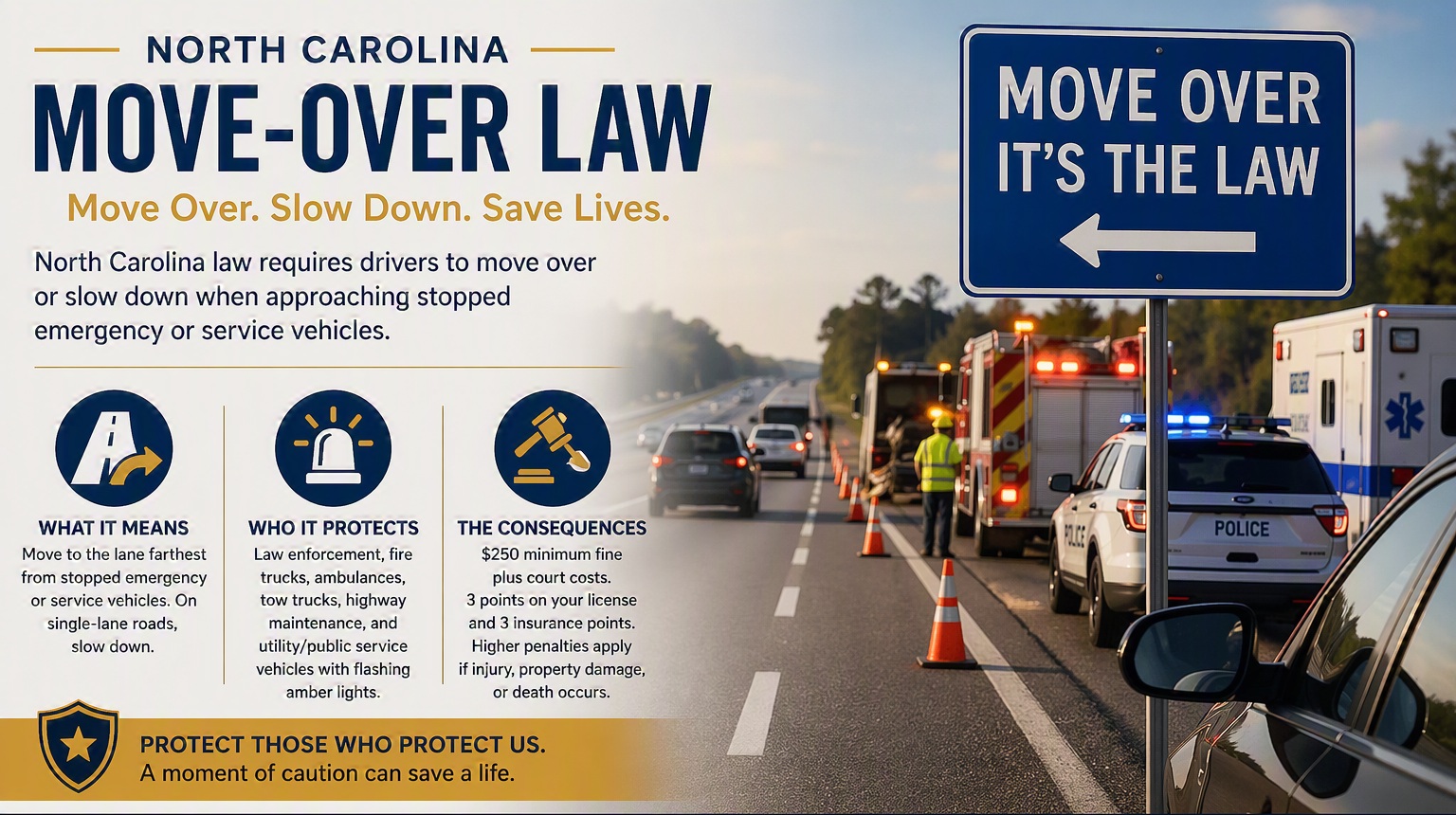 Our roads and highways are busier than ever. Thousands of vehicles travel in North Carolina every day. Often, emergencies require vehicles to pull to the side of the road. Police vehicles, fire trucks, ambulances, tow trucks, repair vehicles, utility trucks, and others are often working along the shoulder. The law requires motorists to move over or slow down when they approach emergency vehicles on the side of the road. This is called the move-over law.
Move Over Law in North Carolina
The move over law in North Carolina (G.S. 20-157) requires vehicles to move over when they see an emergency vehicle on the shoulder. Specifically, the law states that a driver must “move the vehicle into a lane that is not the lane nearest to the parked or standing authorized emergency vehicle or public service vehicle and continue traveling in that lane until safely clear…”.
On multi-lane highways, the driver must move to a further lane. On single-lane roads, a driver must slow down and proceed at a safe speed. The move-over law protects a number of types of vehicles, including law enforcement vehicles, ambulances, fire trucks, tow trucks, highway maintenance vehicles, and utility or public service vehicles displaying flashing amber lights.
Move Over Enforcement
Police enforce the move-over law. A driver who has failed to properly move over or slow down in accordance with the move over law will be subject to a ticket. There is a mandatory $250 fine plus court costs for a violation of the move over law. If the violation resulted in an accident, the driver could be charged with a Class 1 misdemeanor for injuries or property damage, and if convicted, could receive jail time and have to pay fines. If severe injury or death occurs to the emergency responder, the charge increases to a felony with a significant increase in potential penalties.
Can Police Pull Me Over for a Move Over Violation?
Yes, law enforcement officers will pull you over if they see that you violated the move over law. Violation puts them at risk, so they are likely to take steps to stop your vehicle and issue a citation. A move-over violation is a type of moving violation that is considered serious. If found guilty, you will receive three points on your license and will also get three insurance points. Keep in mind that if you pay the ticket, you are admitting guilt. If the violation resulted in injury, property damage, or death, you will be charged criminally and must appear in court.
If there were other vehicles in the way that made it impossible to move over or slow down, you may be able to present your defense in court. However, there may be video evidence showing the incident. If you are facing a ticket or criminal charges, you will want to speak with a criminal defense attorney to determine your options. To learn more, contact our experienced legal team at Arnold & Smith, PLLC, at (704) 370-2828 to schedule a consultation.

The criminal defense attorneys at Arnold & Smith, PLLC make it their mission to zealously defend their clients on a wide range of criminal matters at both the state and federal levels. These matters may include any charge from traffic offenses; DWI/DUI; drug charges (from simple possession to possession with intent to distribute and trafficking); gun permit denials; weapons offenses; and property crimes (larceny, breaking and entering, robbery, fraud, embezzlement, white collar offenses); to sexually related offenses (indecent exposure; sexual assault, crimes against nature, removal from sex offender registry); and violent crimes (domestic violence; assault; manslaughter; homicide, murder).
Other legal issues that Arnold & Smith, PLLC criminal clients may be facing include restraining orders, restraining order and probation violations, expungements; appeals; and immigration issues related to criminal charges. Our criminal defense attorneys are passionate about ensuring that individuals empower themselves by being informed about their constitutional rights and stand at the ready to fight in the defense of those facing criminal charges.
Source:
https://www.ncleg.net/enactedlegislation/statutes/html/bysection/chapter_20/gs_20-157.html
https://www.wptf.com/2026/05/11/14049/
See Our Related Video from our YouTube channel:
Arnold & Smith, PLLC – YouTube
See Our Related Blog Posts:
Restoring Your Driver’s License in North Carolina
What Traffic Infractions Result In Criminal Charges?