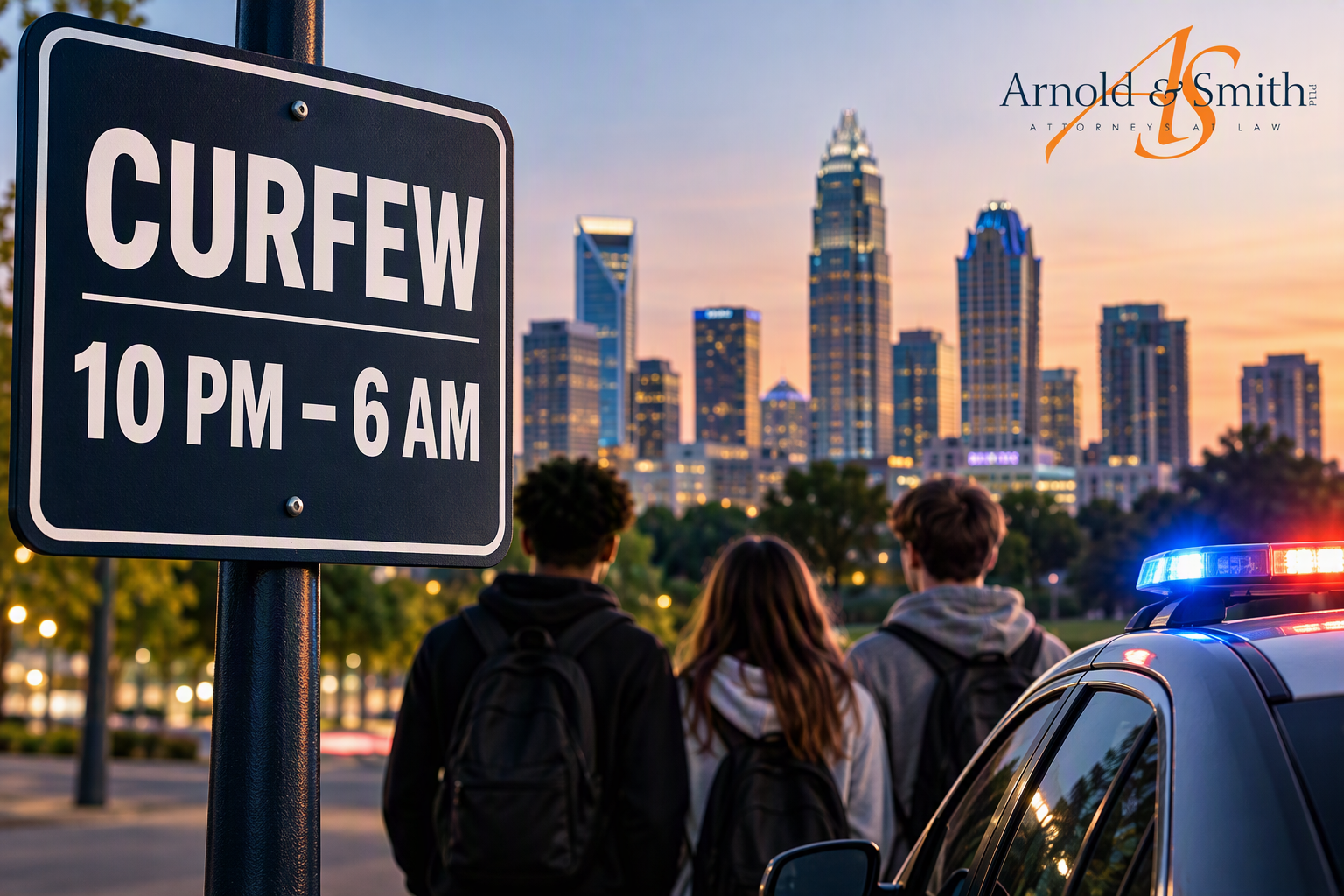
Charlotte Teen Curfew Pilot Program Begins November 1, 2026
Teen takeovers and youth crimes have been on the rise in North Carolina and in cities across the country. Most big cities have been inundated with teen takeovers – where large groups of teens meet in a specific area of the city. Dozens of teens were arrested over the summer in teen takeovers, primarily in prominent areas such as Romare Bearden Park and Camp North End.
These large groups often start out as peaceful hangouts but later may turn violent as time goes on and as more and more teens attend. This is concerning for citizens and businesses and can even wreak havoc on traffic. Some roadways were blocked, including I-77 in Charlotte. The Charlotte City Council has voted to put a trial teen curfew program in place to combat teen takeovers and make the city safer for citizens.
A new law is in place in North Carolina. The Pretrial Integrity Act went into effect on October 1, 2023. The bill was initially introduced as House 813 and was signed into law by Governor Roy Cooper on July 1, 2023. The law is designed to allow judges the ability to make decisions regarding setting bonds for defendants. Proponents of the bill wanted legislation in place to ensure that dangerous criminals would be kept in jail pending their trials.
Mecklenburg County Courts Going Digital – Delays are Expected
We all like efficiency and there is a need to bring all of our governmental processes into the digital age. With this in mind, the court system in North Carolina has been undergoing a transition to digital. The new system is designed to improve the court system with a software package of applications called eCourts. The state-wide implementation of the digital system is expected to cost about $100 million. The system will provide more online access to court activities and allow judges and clerks to complete more of their work from their computers.
Charlotte Criminal Lawyer Brad Smith answers the question: “Can I be arrested without evidence against me?”
Several cities in North Carolina enacted a curfew in response to protests over the killing of George Floyd. In Charlotte, 30 people were arrested during the second night of protests, according to WBTV.
J. Bradley Smith of Arnold & Smith, PLLC answers the question “What is the difference between a misdemeanor and a felony?”
Charlotte-Mecklenburg police office Randall Kerrick avoided conviction on manslaughter charges last week when the North Carolina jury deadlocked, forcing the judge presiding over the case to declare a mistrial. Experts say it is unclear how prosecutors will move forward, whether they will bring Kerrick up on similar charges a second time or consider other options.
Charlotte DWI Lawyer Brad Smith answers the question: What are the long term effects of being convicted of a crime?
Former Charlotte mayor Patrick Cannon found himself back in federal court in Charlotte last Thursday, where he faced the same federal district court judge who sentenced him to 44 months in prison last month.
Judge Frank Whitney told Cannon he embarrassed the city by accepting bribes in the mayor’s office and then embarrassed the city again by voting in this year’s elections.
Cannon cast his votes on October 30 at Community House Middle School, records show. In the State of North Carolina, persons convicted of felonies are ineligible to vote.
The United States Attorney argued that Cannon was a sophisticated voter and should have known that he had been stripped of his voting rights. The government asked that Cannon’s bond be revoked and that he be placed in custody immediately.
Judge Whitney agreed that Cannon had violated the terms of his bond but declined to place Cannon in immediate federal custody. Instead, Cannon will be fitted with an electronic monitoring device and will be confined under house arrest until he reports to a minimum security federal prison in West Virginia at the end of the year.
J. Bradley Smith of Arnold & Smith, PLLC answers the question “Can I be arrested without evidence against me?”
Bill Stevenson became the latest North Carolina magistrate to resign his post in the wake of court rulings that paved the way for same-sex marriages to being in the Tar Heel State. The Gaston County magistrate—like at least six others in the state—cited religious objections to same-sex marriage as the reason for his resignation.
Magistrates, judges and clerks were warned by North Carolina’s Administrative Office of the Courts that if they refused to officiate same-sex weddings, they could be suspended, removed from office, or face criminal charges. Refusing to perform same-sex weddings, a memo warned, constituted a willful violation of a magistrate’s duty to uphold the Constitution of the United States.
The magistrates may be wondering exactly who is bound by the law, since the state’s highest law-enforcement official—Attorney General Roy Cooper—announced in July that he would not defend North Carolina’s State Constitutional Amendment banning same-sex marriage. At the time, Cooper correctly predicted that the Amendment would be overturned, but it is undisputed that he instructed justice department attorneys to ignore then-existing law when he ordered them to “stop making arguments we will lose, and instead move forward.”
Cooper was not alone. At least seven other state attorneys general refused to enforce bans on same-sex marriage. In each case, the attorneys declared that state laws or state constitutional amendments banning same-sex marriage either violated the Constitution or created ethical conflicts for lawyers asked to defend the bans.
Attorney J. Bradley Smith answering the question: “I was found not guilty of a charge, but my record still shows the charge?”
In a surprising and welcome move, Charlotte’s city manager, Ron Carlee, has said that the box that asks candidates to disclose their criminal histories will be removed from applications for most city jobs.
The announcement means that Charlotte joins a league of a growing number of cities across the country that has decided to “ban the box.” These cities include Minneapolis, Seattle and, closer to home, Durham. In each case, city governments decided it was not only better for job applicants, but for the city itself to eliminate the question about whether a person has a criminal record.
Opponents of the trend argue that by eliminating the question, it is possible that city government will employ those who pose serious dangers to their co-workers or even the public. These people believe that criminal records should definitively rule applicants out for jobs, seemingly forever.
Thankfully, these critics have not been able to sway the opinions of managers in places like Charlotte. Instead, supporters of “ban the box” efforts have convinced officials that ex-convicts desperately need work and that by eliminating all of those with criminal records from consideration, the city could wind up losing out on talented and qualified applicants.
Supporters point out that a mistake made years or even decades ago should not singlehandedly make a person unemployable for life. By implementing such rigid rules that come along with the box, cities lose out on talented individuals who are often highly qualified and merely looking for a chance to show their skill.
Attorney J. Bradley Smith answering the question: “What is the difference between a misdemeanor and a felony?”
A grand jury in Charlotte chose to indict a local cop on voluntary manslaughter charges for shooting and killing an unarmed man last September who had just been involved in a late night car accident.
It was revealed earlier today that Officer Randall Kerrick, 28, would now face formal criminal charges in connection with the fatal encounter that occurred late on September 14, 2013. The announcement was made after a different grand jury declined to indict Kerrick just last week on the same voluntary manslaughter charge. Kerrick’s attorney tried to block the second grand jury, asking a judge to deny the second hearing, arguing that giving prosecutors a second chance to pursue an indictment violated Kerrick’s rights. However, the judge allowed the second grand jury hearing to proceed.
Kerrick was a former animal control officer who had been on the Charlotte-Mecklenburg police force for a little over three years. The grand jury heard evidence of how Kerrick fired 12 shots at Jonathan Ferrell, a 24-year-old former Florida A&M football player. Ferrell had been involved in a car accident earlier that evening and stumbled for a half-mile down the road before knocking on a woman’s front door. The young woman was home alone with her newborn child and was afraid Ferrell was there to break in.
Police officers, including Kerrick, arrived shortly after the woman called 911 and appeared to do so with their guns already drawn. Some have claimed that Kerrick and the other officers snuck up on Ferrell and failed to identify themselves as police officers. Ferrell was ultimately shot 10 times and died at the scene.
Attorney J. Bradley Smith answering the question: “Should I talk to the police?”
An officer with the Charlotte-Mecklenburg Police Department has been charged with voluntary manslaughter and is now in custody after authorities say he was involved in the fatal shooting of an unarmed man over the weekend.
According to a spokesperson for the department, Officer Randall Kerrick, is now in custody after the victim, 24-year-old Jonathan Ferrell, was killed during an encounter with police after wrecking his car. The police department conducted an investigation after the deadly shooting and determined Kerrick’s actions were excessive, saying that Kerrick did not have the authority to discharge his weapon during the encounter.
The deadly exchange began when Ferrell’s car crashed into the woods off Reedy Creek Road. The accident was a serious one and Ferrell was forced to crawl out the back windshield of his car. Police have not yet determined the cause of the crash or the severity of the injuries Ferrell sustained as a result. After escaping the wreckage, Ferrell walked to a nearby home, about a half-mile from the accident scene, where be banged on the door. The woman at home thought Ferrell was attempting to rob the house and called police.
Officer Kerrick, as well as two other police officers, arrived at the home a little after 2:30 a.m., believing they were responding to an attempted break-in. Authorities say after surrounding Ferrell, the man charged the officers with one person unsuccessfully firing a Taser at Ferrell. After the Taser missed, Kerrick opened fire 12 times, shooting Ferrell 10 times and killing him almost immediately.
 Charlotte Criminal Lawyer Blog


 Teen takeovers and youth crimes have been on the rise in North Carolina and in cities across the country. Most big cities have been inundated with teen takeovers – where large groups of teens meet in a specific area of the city. Dozens of teens were arrested over the summer in teen takeovers, primarily in prominent areas such as Romare Bearden Park and Camp North End.





 According to a spokesperson for the department, Officer Randall Kerrick, is now in custody after the victim, 24-year-old Jonathan Ferrell, was killed during an encounter with police after wrecking his car. The police department conducted an investigation after the deadly shooting and determined Kerrick’s actions were excessive, saying that Kerrick did not have the authority to discharge his weapon during the encounter.